The South Has Something to Say
- Jun 3, 2023
- 8 min read
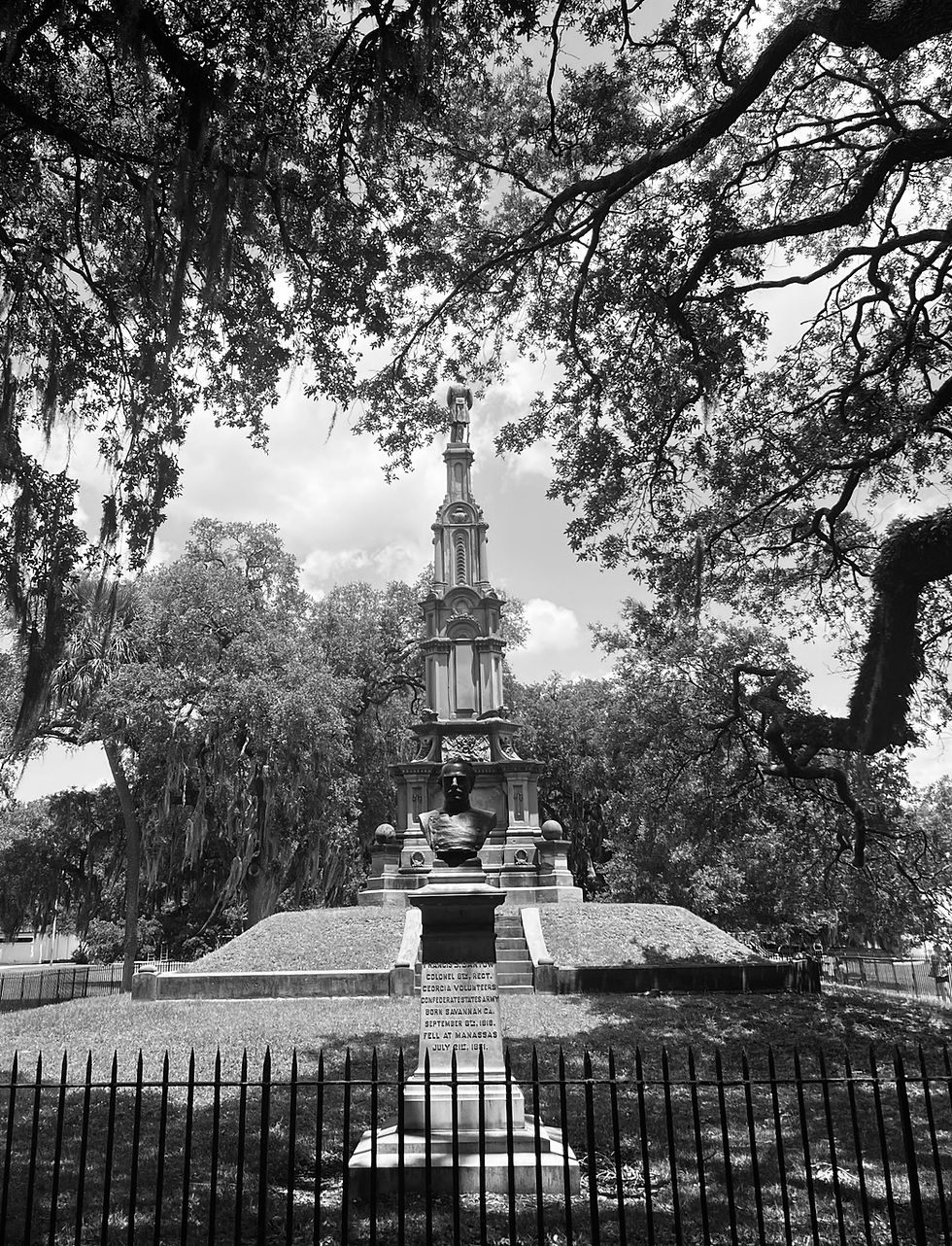
If you asked a certain eye of the beholder, they would tell you Spanish moss was a shriveled hairy accent to a tree that gave them the same reaction as a historic man’s beard, thudding against his grey chest in the wind. Their wife or brother-in-law next to them may answer the question with a cleansing silent pause to add that Spanish moss was an angelic thing to them, decorating the tree with an artist’s hand, America’s first whimsical mobile. The first would point out the parasitic bugs that inhabited them, the second would insist that it didn’t matter, the first would recall that it surely did matter to their right ankle eight years ago, and on and on the discussion would go, in and out of favor of the Spanish moss. The clashing of opinions is a longtime friend, starting quarrels and deepening the dependence of faith within the belief and its host. It’s how America operates and how the battle between pork roll and Taylor ham has never quite extinguished. The doxa of our time, the Greek word for the common opinion, continues to propel a self-defined entropy within society.
As an East Coast northerner, I have inherited filters that emphasize the dichotomy between the north and south. Cold and hot, industry and farm, biscuits and bagels, before any first-hand experience I was informed of all the contrasting ways of life. Something about the southern presence anchors me into a multi-generational crusade. Its stubby palm trees and vibrant harbors cascade centurion bouts of time; back to cotton gins, airplanes, jazz and Confederate banners. I am solemnly aware that this limited view of the southern states comes from an outdated W.B Mason textbook. It keeps me rooted in its most domineering years that coincided with the suppression of human beings. It’s as if every square rimmed park is littered with worm holes, bringing me straight to a place of mysterious hospitality with euphemistic dialogue. This is similar to the cinematic art found in the discussion of a Paris named quarter-pounder in the misfortunate car of Travolta and Jackson. Trolleys that point out ghosts, cavalry, the best place to eat beignets, encourage me to dive deeper. And at the heart of my time in the south I catch myself teetering worlds, progressive and chained, with my own momentary dilemma of absorbing the dirt’s hereditary trauma and where my next sweat tea will be.
For such a kind, personable, and gracious city, the words left unsaid cling to me. There’s an urge to scatter crystals of the throat chakra-Aquamarine, Sodalite, Lapis Lazuli- all over the communal walkways in an attempt to unlock the massive throbbing of suppressed voices inside my head. In my imagination it would allow these aching vocal cords to sing free at last, an over-pouring of pleads and honesty that would rebalance its foundation. This desire leads me to think about the noble spirits who have broken such strides, Rosa Parks and Martin Luther King Jr., the phenomenal Ella Fitzgerald, iconic Maya Angelou, making my adoration of them deepen even further. If it was hard to be heard or understood in today’s modern world, imagine the barriers these role models were left to find meaning in.
An example of a southerner with a majestic unlocked throat chakra would be the man himself, André 3000. Synergized in an Atlanta mall, he and Big Boi formed the enigmatic group called Outkast and crafted lyrical genius after lyrical genius of rap for two decades. Every song André features in is destined to turn gold, standing out alongside superstars like John Legend and Beyonce. In recent years André has hung low, exploring different alternatives for the creative mind. But in the nineties and early two-thousands, Outkast made great strides in southern representation. At the time well-known artists were only coming out of two places, New York and Los Angeles. If Kanye was struggling to be respected from Chi-town, getting in anything noteworthy from a southern state was nearly impossible. Outkast understood their odds but continued anyway, compelled to manifest their work through an artist’s purest source; obligatory authenticity.

After years of underground dedication, Outkast won best new rap group at the 1995 source awards. It was a shocking win as most were expecting another New York name to be announced. Big Boi and André walked to the stage with deafening boos, loud enough to mask their well-earned speeches and deflate the honor of the moment. After an uncomfortable length of jeers, André took hold of the mic and with a magnet heart on his shoulder gave the iconic announcement:
“The south got somethin’ to say.”
This affirmation enabled the duo to receive the attention that they deserved and Outkast would go on to build an empire, dominating the music industry with chart toppers, extraordinary verses of poetic conviction, triumphing car speakers and walking red carpets dressed in the ROYGBIV nines. André 3000 would forever be known as one of the greats and inspire generations of new artists to come.

But before André even existed, or took his humble steps to the main stage podium, the south has always had something to say. The Spanish moss drapery has been here, along with the tall beebalms cuddled along the grass and the passionate citizens that called it home. Every human in existence is plagued with the urge to express the kettle pot within them; pain, desire, anger, joy, jealousy, frustration. It’s the spectrum of expressions that keeps Lin Manuel highly praised, movies felt and connected, dances choreographed, paintings copied, on and on until the final cessation of voice.
And in this unquestionable human right I find the lingering sadness that greets me in the southern air; this messy collection of suppressed words. The dramatic necessity of reliance in euphemisms such as “Bless your heart” interpreted with offhand irritability or passionate atrophy, to the interpreter’s unique discretion alone. The over exclamation of manners, tradition, and inheritance threads a web of censorship in the day to day lives of those who live within them. And as much as we’ve grown into the free-thinking society we cherish today, the fear of the enormity of such an ongoing loss leaves me unsettled.
In the literary work of acclaimed NY magazines, this token of diverse voices is a selling point to the accredited reader. They can page through the best thinking prose of the month; reaching political wars, celebrity bios, and relatable vexing saturations. But for all the clout that’s held in the name with the wide worldview and positive initiative, are these mediums of voices really that inclusive? The marketing campaigns within them can tell you no- Rolex ads, British prep schools, ivy league broadcasting. If you still don’t believe me, take the following two sentences into consideration:
That Monday morning, I had a mental breakdown in Riverside Park.
That Monday morning, I had a mental breakdown in Iowa City.
Both of these give the reader a moral sense of empathy. Clearly the author is having a hard time. But one of these sentences elicits more of an unraveling- a steady head nod if you will- that encourages the reader to invest further, connect deeper, and acknowledge the feelings of the author. Do you already know which one I’m talking about?
New York, of course. The ecstatic hit of referencing Riverside Park, its well paved walk ways and dark tulip gardens that frequent the morning runner and gentle dog walker, magnifies the voice. Nothing evokes a literary appreciator more than reading about the top-of-the-top-world destination. It seems that everywhere you read, New York is with you. Whether in the author’s bio, adoration, routine, or harmless name-drop, the towering city is ever-present in the words we consume.
There’s nothing wrong with writing about New York- I love New York, I’ve lived there -its majestic and influential. Even saying that I have lived there gives a strange sixty-dollar-paper-weight of quality without even reflecting if my writing is good or my topics make any sense. There’s a problem with this oversaturation and resonance for the New York voice. Both sentences should warrant the same amount of empathy and infusion with the author, but they don’t. Any well-known high paying area is going to trump the voice of the lesser-than patron 10/10 times. You’re struggling in Iowa city? That sucks, I’m sorry. You’re struggling in Riverside Park? My sympathies, how did that happen?
Of course, there are articles that venture beyond the big city in these magazines. But a lot of them tend to be more dramatic scenes of extremism; natives in a rainforest, an exotic slum, the language of a dying tribe. What isn’t New York or a mega city center is considerably polarized. It makes me wonder how many articles are not used simply because the association of a noun wasn’t a high and mighty one? How many tossed works of the Appalachian Mountains, Sierra desert or suburban Milwaukee were tossed to make room for a “brighter” voice? How many times has location, race, background and privilege decided who gets heard and who does not?
How many times has the south had something to say and no one listened?
With this background you could say the literary world is suspended in the same 90’s rap exclusivity that haunted Outkast. Progressive and diverse, yes, but not at all at the level the world needs. These articles are not stretching the bandwidth to meet the masses, but encouraging the same finite group of people to share comfortable stories. If a magazine’s argument is every business needs a target market, I would argue you can still cater to these people while simultaneously extending the content. I’m sure the individual consuming the story would gladly accept the callout that they need to expand their minds. Afterall, the most prestigious thing is to be otherworldly, conscious, and an astute neighbor. It can be done and its rewards would be fruitful.
This concept of equal speech was no stranger to the ancient Athenian. The term isegoria is directly translated into equal speech in public. Its derivation is less about the well discussed “freedom of speech” and more along the lines of equality of speech. Citizens were expected to practice parrhesia, the honesty and courage to tell the ugly the truth, no matter the consequences. With this mindset the Athenian quest to find a broad range of voice was the pristine ideal, along with the understanding that these at times offensive hot takes are allowed and welcomed because they further progress a society. Unfortunately, ancient Athens had its own hiccups to deal with and eventually ended up sentencing its own Socrates at the fault of his free expression of speech. While the global world is a stronger constituent of the democratic practice, the push to excel, to exemplify a society even further, is a constant standard. In the decree of John Mill, “If any opinion is compelled to silence, a society would miss the truth.” In extension, if any opinion were destined to suppression, a society would misjudge the truth.
I realize that I come from a very privileged background and my insights into these suppressed voices are not the full story and will never match the real representation that they deserve. I only come from a place of curiosity and hope that the voices of the future are not suppressed by irrelevant nouns. I hope that when the South has something to say, I can listen to it with an open mind, whether I agree with the point of view or not. However the Spanish moss may look to you, I hope we can encourage these conversations with a fine-tuned isegoria both the ancient Athenians and André 3000 would be proud of.


Comments